

The following paper has been published: Modular Strategies for Global Lithium-Ion Battery Recycling, Resources, Environment and Sustainability 2026; https://doi.org/10.3390/s25247689. The paper, expressing a viewpoint of the coordinator, argues that Europe’s lithium-ion battery recycling is held back by fragmentation—scattered capacities, non-harmonized routes, and weak comparability—which contributes to “black mass dependency” and significant exports of black mass, with loss of value and know-how. It contrasts this with China’s advantage from vertically integrated, co-located recycling and manufacturing ecosystems. As a solution, in the frame of the experience of the CARAMEL project, the author proposes an integrated, modular “plug-and-play” recycling center to benchmark and optimize multiple recycling pathways (mechanical, thermal—including microwave—hydrometallurgy, and possible direct regeneration) under standardized analytics, shared reference data, and consistent TEA/LCA metrics (energy and cradle-to-gate emissions). The goal is a transparent framework that accelerates scale-up and resilience as battery chemistries evolve.
The papr has been highlighted by ANSA:
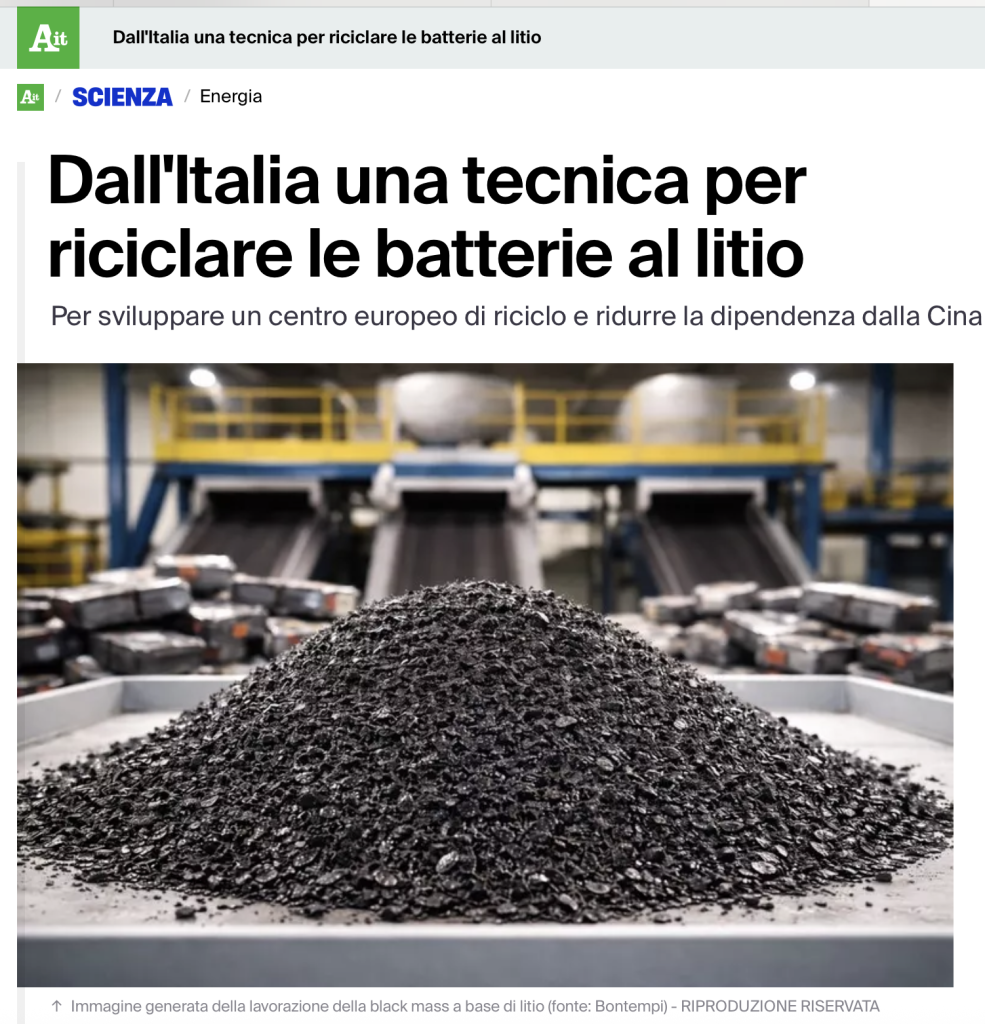
See the other journals articles about that.
https://www.giornaledibrescia.it/gdb-futura/centro-riciclo-europeo-litio-elza-bontempi-f30881ee